
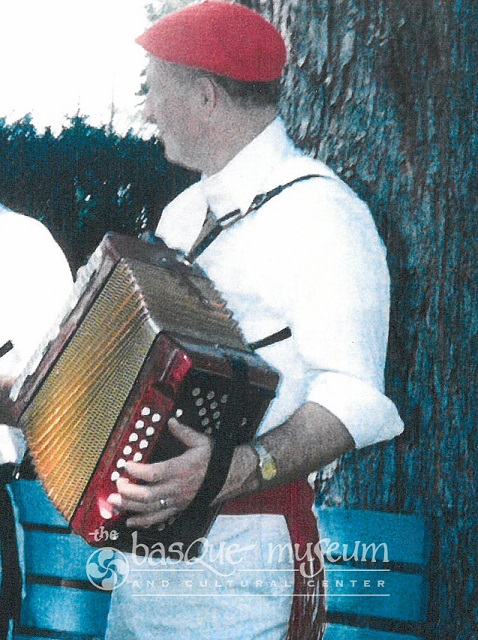
John was born on 6 March 1931 in Mountain Home, Idaho, to Basque immigrants Cipriano Barrutia and Juanita Mandiola. His father had worked in the United States as a young man, even starting his own sheep ranch, but a call to duty from the Spanish military brought him back to Euskadi, where he married John’s mother. The couple found a very different America when they returned–devastated by the Depression–and the sheep company they were relying upon was lost. John vividly remembers his early life as his parents struggled to raise their family (losing a few children along the way) during hard times, but notes that life had its wonderful moments as well.
Even though John grew up speaking Basque at home, he was quick to learn English once he began school, and except for a few tensions during WWII, he always felt very integrated into the Mountain Home community. Overcoming a debilitating knee injury to the surprise of all, John went on to become an accomplished athlete, an industrious worker, and a loyal soldier during the Korean War. He used his GI bill to obtain a degree from the University of Washington, and later worked on a variety of private and government contracts. John wed French Canadian Marie Perrin in 1964, and has 4 living children.
Today, John remains active both within and without the Idaho Basque community. He is an avid runner, and participates in several annual races. John was also a charter member of the Oinkari dance group, a passion he has passed on to his kids. He involves himself in the Mountain Home Basque Association, and has taken a few trips to Euskadi to see his parents’ homeland. All in all, John Barrutia is a very proud American Basque.
TAPE MINUTE SUMMARY OF CONTENTS
Tape 1
Side 1
0-9:00 John’s parents were Juanita Mandiola (born June 24, 1901, in Cenarrusa; moved as a child to baserri Karrietorre in Markina) and Cipriano Barrutia (born 1891 in baserri Patrocua in Markina). Both had worked as farmers raising cows, chickens, pigs, and foodstuffs, but since Spain was very economically depressed, everyone was looking for a land of opportunity. Cipriano came to the US in 1918 to make money; as he was not the oldest boy, inheritance was not in the cards for him. Juanita boarded the La France in Bordeaux (before this, she had never traveled more than a few kilometers) as an 18-year old girl, and always talked about how sick and scared she was. Cipriano was engaged with the Whitson brothers in the US, helping them start up a sheep company, but he soon received a telegram from the Spanish government demanding his return for military service. He did so, and married Juanita (who had also returned) before returning in 1921. When he got back, however, the Depression had hit the US and his sheep business went bankrupt, leaving the couple with nothing. They spent their first few nights in a bedroll under the stars 7 miles from Mountain Home in a place called Rattlesnake Station. Cipriano soon began working for the Gandiaga Sheep Company until he had earned enough money ($6.50) to buy their first house, a teepee tent. His aspiration was to have his own sheep company, which he started in 1927 with American MC Swain [John describes the range] under the name Yuba Sheep Company. By this time, all John’s oldest brother had been born. John was born in 1931.
9-14:00 The family spent their summers near Mountain Home, and their winters in a tent in Kuna. The winter days were freezing, and John remembers being cold all the time, despite a pot-bellied stove. The winter camp was eventually moved to Grandview. He described the subsequent change in the sheep trail. John’s mother was always a very hard worker, and cooked most of the meals both for the Gandiaga company and the Yuba company. She also did the laundry and raised the children. When the children were old enough to begin school, Juanita thought they needed a more permanent residence, and so rented the family’s first house in Mountain Home. Around the same time, they got their first cow, which meant the first fresh milk in a long time. This later turned into a significant dairy, which Juanita operated herself until 1955, milking the cows by hand and delivering the milk. When the children entered the military, Juanita had to buy milking machines.
14-24:00 John was born March 6, 1931 in the Bideganeta boarding house in Mountain Home, since the family was living in the tent. She had already lost her 1st 2 children (Margaret and Juan) to the rigors of mountain life, and so risked no such hazards for Rafael (1927), John, and Richard. John remembers being very loved by his family, and never paid much attention to their poverty. As a child, he did not know the “opulence of materialism”. He remembers that during the winter, there were ice crystals on baby Richard’s diapers. The tent may have been cold, but it was customized: Cipriano had installed a wood floor and wood sides in addition to the stove. The cook shack was the warmest place in the compound, which had plank flooring (easier for John’s mother to sweep) and cardboard box insulation. The employees of the Yuba Sheep Company included Basques and non-Basques Cipriano hired for skills; all went by nicknames, including Wink, Shorty, Dutchman, and Morga. At any given time, there would be about 20 people working in the winter camps. Juanita was the only woman except visitors, but was helped a lot by her children to complete the daily chores, and MC Swain liked to cook as well.
24-30:00 The predominant language around the sheep camps was Basque, except for the smattering of English from the American herders. John started school in Mountain Home when he moved there with his family at the age of 6, where he learned most of his English, helping his mother and little brother to learn as well. Cipriano spoke a very broken English, since he had very little exposure to the language apart from his partner. Juanita did very well in English, going to church, meetings with teachers, and stores. When John moved to Mountain Home, he was very excited by living in a house with real wood and having a permanent toilet (even if it was outside). He was also surprised by the new routine school imposed on his life. John, along with the other Basque students found it fairly easy to pick up English, facilitated by patient teachers. Some of his Basque school friends were Philip Aguirre and Dolores Echevarria, although he had many non-Basque friends as well.
Side 2
0-5:00 As John was growing up in Mountain Home, the relations betweens Basques and non-Basques were great (especially for kids). When WWII rolled around, however, anybody who was a foreigner became suspect following the bombing of Pearl Harbor. John recalls a few insults, but ignored them, since he knew he was a citizen. His brother Rafael once got into a fray over insulting remarks directed toward his parents. German immigrants also made their homes in Mountain Home, and suffered equal prejudice at the time.
5-16:00 For fun, John enjoyed going with his parents to the boarding house downtown, where someone was always playing the accordion. Those were the days when families visited each other frequently (the Depression being a great equalizer of financial situations). As he grew up, he liked to fish with willow poles, hunt for rabbits and venison, play soccer, have races, and go to dances. During the festive seasons, dances were quite common, and sheepherders descended upon the town to participate. As a kid, John rarely noticed if the majority of the people attending these events were Basque, but in retrospect, esteems that this was the case. Many non-Basques close to the Basque community were warmly welcomed to these events. This time of year, it was common for sheep ranchers to recruit the best herders from this congregated bunch, often enticing them away from rival sheep owners. The worst thing a rancher could hear during this crucial time was “I’m gonna roll up the bedroll”.
16-26:30 In high school, John was an avid hunter, and remembers having a bad car accident one autumn that really damaged his knee. He recalls overhearing the doctor tell his mother he would never regain full use of his knee, so as soon as the doctor left, John through his crutches to the floor, determined to exceed everyone’s expectations. He walked into the backyard that warm fall evening, and promised himself he would avoid the taunting of the other kids by walking to school. The 2-mile round trip was torturous, but his knee got better, and John joined the track team his senior year. He even played some football! After he had graduated and gotten his first real job at the Anderson Dam (doing construction), John forgot all about his bad knee, and when he was called to the Korean War, he wanted the GI Bill so badly that he did his best to pass the physical. This he did, and was soon stationed in Germany, where he participated in various Air Force races. John was invited to a prestigious New York race, and also got a little free time (the first in a few years) to return home for a visit. He ran into the doctor who had given him the grim prediction of life as a cripple, who was elated, and said it was never too late to learn. John, still runs today (at age 71), and has recently signed up for Boise’s Robie Creek Race—his 10th.
26:30-30:00 John explains how he had found out about the Anderson Dam job after graduation: he had become friends with the kids of men and women who worked there who were bused into his school. This was the beginning of his federal employment, as he technically worked for the Bureau of Reclamation. He worked in maintenance, frequently using jackhammers to drill holes into the sides of cliffs for dynamite (suspended by ropes, of course)—exciting work! John met a secretary at the dam, who happened to be on the draft board. She told John where he fell on the list, allowing him to join on his own.
Tape 2
Side 1
0-11:00 John elected to try out the Air Force, since he had heard that 4 years there translated into a 4 year GI Bill. After tech training in the US, he was shipped to Germany in 1951. He was stationed in Dickberg for a year and a half, where the first German jet had been tested. John went to a brand new base near Luxembourg after that. John finished with the service in December of 1955, with the rank of staff sergeant. He had run for the Air Force all the while he worked as a crew chief on the various jets. When he had returned to the US, he had to seek employment, and since Anderson Dam had been completed, he got a temporary job with the Bureau of reclamation in Boise. After 6 years with the government (which gave him a bit of seniority), he was transferred to the Mountain Home Air Force Base, where he worked in a civilian capacity. In 1957, he made the decision to attend Seattle University, getting a degree in civil engineering in 1961. John worked a bit for Boeing in Washington, then transferred to the Martin Company, which was installing missiles in Idaho. When this was complete, he went down to Littleton, CO, to install newer missiles there (he explains the different types of missiles he installed).
11-19:00 John wanted more stability in his career, and so jumped at another opportunity to return to the Mountain Home Air Force Base, this time as a civil engineer. It was 1963, around the same time that he met his future wife, who was an Air Force nurse there. Marie Pauline Perrin, a French Canadian born and raised in Maine. John had never felt any kind of pressure to marry a Basque woman (though he would have followed his heart even if he had felt pressure), and the couple was wed in 1964. Their children are John Jr., Paul, Tonya, (a child who died), Patricia “Patty” and Julia. John had chosen to return to Mountain Home to find his “roots”, which included the Basque community. His father had also been badly burned in a recent accident, and John helped run the family farm. The Basque community has gotten older, but not bigger. John has worked with his children so that they were exposed to the Basque culture, but with a non-Basque wife, the language never stuck. The kids were involved with the Oinkari dancers in Boise, however.
19-30:00 John was a charter member of the Oinkari dancers, which he had helped start with friend Simon Achabal, Al Erquiaga, and others. John had just finished school in Seattle when Louise Shaddock from the Governor’s office told him that Idaho needed something to represent it at the World’s Fair in Seattle, and she suggested something Basque. This was the beginning of the group, and when Jimmy Jausoro signed on as the music, things got rolling. Traditional costumes and a lot of practice led to quite a success in Seattle in 1962! The Basque community was elated to have this group, and Boise exhibitions for Basques and non-Basques alike were very popular. John later encouraged his own children to get involved, and they made many trips to the Basque Center in Boise for practice. The Barrutia family also loves to attend Basque picnics, festivals and the grand Mountain Home Sheepherders Ball (with which John was heavily involved). He has also worked closely with the Basque Club in Mountain Home, which started around 1956. The church needed a new organ, and the non-Basque members of the community thought that a Basque dance would make a good fundraiser. The ensuing event easily paid for the organ, and the idea for a permanent organization was born. Internal differences in recent years have caused the Mountain Home group to drop in membership and activities from their stupendous cultural zenith. Many things are still done, however, to preserve the Basque culture, including the fronton, picnics, and dances.
Side 2
0-13:00 John adds that he was a charter member of the Mountain Home Basque Association, and has served on the board of directors and as chairman (around 1967). He has not been very intensely involved recently (but thinks this may be excused by all his prior service, both to the Mountain Home Basque community and to the Boise one. John visited Euskadi for the first time with an army GI friend of his, and again with 2 of his daughters the year after he retired. He was very happy to meet all his relatives (which he grew up without), and his language skills served him well. Both trips were wonderful, and John still keeps in touch with many people. He considers himself to be a proud American who is also very proud of his Basque ancestry. John describes his father’s naturalization.
NAMES AND PLACES
NAMES:
Achabal, Simon: helped start Oinkaris
Aguirre, Felipe: John’s school friend
Barrutia, Cipriano: John’s father
Barrutia, John Jr.: John’s son
Barrutia, Juan: John’s brother
Barrutia, Julia: John’s daughter
Barrutia, Margaret: John’s brother
Barrutia, Patricia “Patty”: John’s daughter
Barrutia, Paul: John’s son
Barrutia, Rafael: John’s brother
Barrutia, Richard: John’s brother
Barrutia, Tonya: John’s daughter
Bideganeta family: owned boarding house in Grandview where John was born
Boeing Corporation
Echevarria, Dolores: John’s school friend
Erquiaga, Al: helped start Oinkaris
Gandiaga Sheep Company: employed Cipriano
Jausoro, Jimmy: accordion player
La France: ship John’s mother took to America
Mandiola, Juanita: John’s mother
Martin Company
Mountain Home Basque Association
Oinkaris: Boise Basque dancers
Perrin, Marie Pauline: John’s wife
Shaddock, Louise: suggested sending Basques to World’s Fair
Sheepherders Balls
Swain, MC: Cipriano’s sheep partner
Whitson brothers: employed Cipriano in the US
World’s Fair
Yuba Sheep Company: co-owned by Cipriano
PLACES:
Anderson Dam (ID)
Basque Center (Boise)
Boise, ID
Bordeaux, France
Cenarrusa, Spain
Dickberg, Germany
Grandview, ID
Karrietorre: John’s mother’s baserri
Kuna, ID
Littleton, CO
Maine
Markina, Spain
Mountain Home Air Force Base
Mountain Home, ID
New York
Patrocua: John’s father’s baserri
Pearl Harbor
Rattlesnake Station, ID
Robie Creek, ID
Seattle, WA
THEMES:
Dancing
Discrimination
Education
Great Depression
Immigration
Korean War
Language
Sheepherders
World War II