
No summary at this time, please refer to the detailed index below.
0-5:00
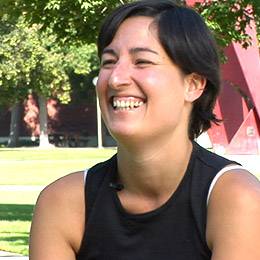
Izaskun is from Sondika in Bizkaia and teaches the Basque language at the Basque Museum, coordinates with Basque language instructors in the United States and Canada, and teaches Spanish at Boise State University. To Izaskun the Basque language is unique because it is the only language to survive in Europe after the European invasions. The Basque people kept the language alive because it was important to them. It is an isolated language that isn’t related to any other language; its closest relation might be to a language that has already died. Izaskun believes that the Basque language should be preserved because it’s a big part of Basque identity and specifically because it’s a language that has suffered a lot of repression throughout history: it was forbidden during Franco’s dictatorship for 40 years, and even before that, in the 17th and 18th centuries. That oppression motivated people to fight for their language and culture.
5-10:00
After the dictatorship, the Basque government made a huge effort to help the Basque language through television and radio and creating an entirely Basque school system. In addition, anyone working for any public system had to know how to speak Basque as well. The government also provided grants for the Basque diaspora all over the world, so that people could preserve the Basque culture outside the Basque Country.
Izaskun believes that the Basque language’s situation has improved a lot; however, she thinks that there’s still much work to do in that field.
In Boise people can attend Basque language lessons for adults and children, as well as online. There are also Basque song-dinners for people to learn Basque songs, Udaleku summer camps; in any situation that there is a chance to teach Basque, they take the opportunity. In the academic field, the universities in Reno, Nevada, in Boise (Boise State) and in California teach Basque language. Izaskun also mentions the Boiseko Ikastola, the Boise Basque preschool, which is the only one outside of the Basque Country, and teaches everything in Basque for children from 2 years to 6 years old. Izaskun believes that children who learn some Basque at early ages (in the Ikastola, for example) will learn Basque easier later on in life, because they will still keep some memories about what they learned of the Basque language as kids.
10-15:00
Izaskun thinks that the main motivation to learn Basque as a person who is living outside the Basque Country is that when they go back to the homeland, they want to be able to relate to the culture and communicate with their relatives. They want to feel a part of the culture.
Izaskun explains that for many years the Basque sheepherders who emigrated from the Basque Country to the United States, they tried to learn as much English as they could and became Americans, so they wouldn’t be rejected from society. But nowadays many of them feel it’s a shame that their descendants are not able to speak Basque. Currently, by teaching Basque to younger generations they make sure that the chain doesn’t break, because, according to Izaskun, once the chain is broken, it will be so much harder to keep the Basque language alive in the US.
Korrika is a fundraising or charity run in favor of the Basque language. Korrika has been celebrated in the Basque Country every two years for the past 36 years. Apart from raising money allocated towards Basque Language Schools, the other aim of the event is to spread awareness about the language.
This year (2011) Korrika has been celebrated for the very first time in the US, precisely in San Francisco (California), New York City (New York), Boise and Mountain Home (Idaho). Izaskun has helped organize the event in Boise and she is happy with the results. They have decided they will organize the run every year from now on and hopefully more Basque Clubs and Centers throughout the US will join them.
Izaskun believes that social media is a great way to get the word out about any events, especially because it’s popular, cheap and fast. For many events, they’ve been utilizing Facebook, for instance for the Korrika event or the Basque lessons offered.
15-20:00
Skype is also becoming helpful. At Boise State they are training people to become online Basque teachers and this way people learning Basque on their own can practice oral skills, even when they are in different countries.
One difference that Izaskun notices between Basque Culture in the United States and the Basque Country is that over there people don’t need to work to get the culture because they are surrounded by it. In the contrary, in the diaspora you need to work hard. You may have to drive many hours to go to a Basque festival, whereas in the Basque Country you’re exposed daily to the food, sports, music and any other cultural aspect.
In Izaskun’s opinion the reason why so many people in the US are willing to travel for so many hours in order to attend a Basque event is the sense of community they feel when they are surrounded by other Basques.
Related to that, Izaskun explains that in the United States if you just feel American, you’ll probably feel that you are lacking something, because nearly all the Native American culture is lost, so there is nothing traditionally American and the culture is a mix of many other cultures.
20-25:00
To Izaskun to be Basque can mean many different things, there are many different aspects of the culture. Izaskun identifies most with the Basque language, as she was raised to only speak Spanish because her parents weren’t allowed to learn/speak Basque during the Franco’s dictatorship. She feels that Franco took the language from her family, and the Basque people in general, so she and her sisters had to make a big effort to learn Basque when they were teenager. Because of that effort she had to make to learn Basque she really values the language and feels it’s a really important part of the culture.
NAMES, PLACES AND THEMES
NAMES:
PLACES:
Boise, Idaho
Canada
Mountain Home, Idaho
New York City, New York
Reno, Nevada
San Francisco, California
Sondika, Bizkaia, the Basque Country (Spain)
THEMES:
Clubs and Organizations
Community Events
Festivals
Franco’s Dictatorship
Immigration
Language
Nationalism
Prohibition
Social Media