
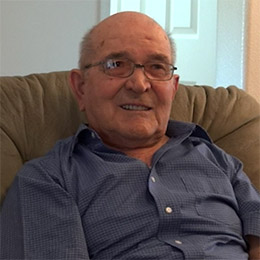
No summary at this time, please refer to the detailed index below.
0-5:00 Frank’s parents are Marcos Aguirre and Maria Aldeturriaga. They were both born in Zeberio, Bizkaia. He had seven brothers and sisters. Frank’s mother died when he was 5 or 6. His mother died during childbirth. His father was told that they shouldn’t have more children, but they did anyway. Marcos worked in Bilbao and unloaded boats for part of his life. Marcos developed the habit of drinking and liked being with women. When the Civil War started in Spain the children went to an orphanage in Bilbao. Marcos used to see the children every day, but one day stopped coming. The children were taken to France and lived there for three years. Eventually Marcos found out where his children were and brought them back to Spain. Frank doesn’t know why he did that, since they were always hungry in Spain but always had food in France. While in France, the children were sent to different places, but were able to meet once a month.
When they went back to the Basque Country the situation was worse, since much of the livestock had been killed off. Due to this, Frank had to start working at around 11 or 12. Marcos would go to work and come home once a week. He eventually stopped coming home and the children scattered. Frank went to school when his mother was alive, but when the Civil War started he stopped going to school.
5-10:00 Marcos got hit by shrapnel from a bomb. Someone got Frank to see Marcos. It was at this time that the five youngest children were sent to an orphanage. They stayed there for about five weeks. Frank remembers hearing the bombs being dropped. After five weeks the children were put on a boat and sent on their way to France. Frank doesn’t know who ran the orphanage, but suspects it was the government or the church. The people Frank lived with treated him well. Frank says that he didn’t have a choice in coming back to Spain. He doesn’t know why he came back since his father rarely saw them and everyone was hungry in Spain. Frank speaks three languages and understands four. Many people have asked Frank talks about how he finds a job since jobs were hard to find when he was young. He said that if he looked hard enough there was always a job available.
10-15:00 Frank started working in Berriz, Bizkaia at around 11 years of age as a sheepherder. He didn’t ever make much money, but one of his brothers and his father would find him once a year and take his money. They used the money for alcohol and women. After this he went to Mutriku, Gipuzkoa. His father eventually found him and the same thing that happened in Berriz, happened in Mutriku. Frank decided this was the last time his father and brother were going to take his money so he made his way to France. He made his way to Dax. He was once grabbed by German soldiers and worked on a farm to make some money. He earned enough to be able to take a train in order to get one of his old jobs back. His old job had already been taken over by another boy at this point. Due to this he started working in a factory that made ropes for ships. He made enough money and decided to go back to Spain. Frank wanted to go to the United States, but hadn’t served in the military yet. He joined the army in Spain and he didn’t do much, but he did learn how to clean and shoot. Frank wanted to shoot, but others in the army didn’t want him to. He thought he was going to have to serve six years in the army. He went to the American Consulate and told them his story and was told he may get out of the army earlier depending on behavior.
15-20:00 Frank served 18 months and during this time he served for the Captain. He got the Captain’s kids from school and helped the Captain. Frank talked to the Captain and was told he was probably going to go back before two years. He thinks it may be because he had good behavior the entire time. Once a captain tried to learn French and learned that Frank knew French. They would often go on walks together and talk in French. Through this the captain was able to learn French. Frank didn’t realize he was discharged for a day, since the Sergeant never gave him his papers. Frank went back to the Basque country the day he knew he was discharged. Frank says that he liked to work and still does like to work even though he is around 90.
20-25:00 Frank was a sheepherder in Berriz. Sheepherding in the Basque country was very different than sheepherding in the United States. In the Basque country the sheep aren’t herded. They are sent to the mountains where they stay all summer. In the winter the sheep are brought to the pastures. The lambs were usually sold in Gernika. In America someone had to stay with the sheep for the whole year. In Berriz, Frank was responsible for about 160-170 sheep. In America Frank could be in charge of up to 12,000 sheep. In the early 1950s Frank decided that he wanted to come to the United States. He had a friend that had a cousin in Blackfoot, Idaho. His friend knew that Frank wanted to herd sheep in the U.S and so his friend informed his cousin. Frank eventually went to work in Blackfoot. Frank didn’t have to sign a contract when he came to the United States. He was given a green card when he was in New York. Three years after Frank came to the U.S. a two year contract was needed to get a green card. Frank took a plane to get to Blackfoot. He landed in Salt Lake and stayed there the night in the Hogar Boarding House. Franks speaks about Sabino Arrin who was a sheepherder that became a camp tender, since he was nervous around sheep.
25-30:00 Frank was picked up from the boarding house by Johnny Garro. During Frank’s first year sheep herding in America he and a camp tender had a disagreement. Frank was told he was going to be sent back to Spain by the camp tender, but he never was. Frank worked for a sheep company for 10 years and left twice. He usually wasn’t paid like he was told he was going to be paid.
30-35:00 Frank was trucking water for sheep when his old boss from Blackfoot came to get him to work in Blackfoot again. He quit for a second time and was asked to come back to work in Blackfoot while he was living in Emmett. Frank said no this time, since he had a family and never got the wages that he was promised. When Frank herded sheep in Blackfoot the lambs were born in February and March. In April the sheep used to be in Pocatello. From there they would be taken to Caribou Mt. The sheep were brought in trucks. There were about 8,000 sheep involved. In the summer the sheepherders were given tents. In the fall Frank used to go to the Basque boarding houses in Rupert.
35-40:00 The first year Frank was in Blackfoot there was a night man. The sheep would lamb and be put into individual pens. Frank was in Rupert when he was told he had to go back to Blackfoot. There weren’t many Basque in Blackfoot so he had to learn English. After that he became a foramen, but quit since he didn’t get paid. By 1964 Frank had gone back to the Basque country. In 1963 he went for a visit and was planning on getting married. He planned on bringing his wife back, but was unable to. He learned from the American Consulate that he could apply for citizenship in America. Frank paid 5 dollars for his citizenship papers and never had to take a test. He became a citizen and went back to the Basque country where he married his wife Nieves.
40-45:00 Frank and Nieves went to many places on their honeymoon. They went to Valencia where Nieves stole some oranges, since no one would let her have any. When they got back from their honeymoon they lived in Rupert. As a foramen he would bring groceries to the sheepherders and take water to the sheep. Frank worked seven days a week. In 1964 he began to work for Soulen. When he began working for Soulen he and Nieves lived in a trailer house in Emmett.
45-50:00 Soulen had lambing sheds in Emmett. In 1964 he was the foramen for the Soulen sheep company and was in charge of 16 workers. Crews came in the spring to help with shearing. A lot of crews were from New Zealand. Each man could shear 200 sheep a day. Nieves used to be a cook for the Soulen Company. She made meals at 6 in the morning, noon, and 6 in the afternoon. Frank was the foramen for 30 years. The industry did change a lot in those thirty years with the forest service and BLM.
50-55:00 Frank did have a lot of problems with coyotes, bears, poison, and lightning. He says that one night he lost about 258 sheep from lightning. During his time there weren’t any problems with the wolves, but they are a problem now for sheep. When Frank worked with the sheep he had Australian Shepherds that helped with the sheep. He doesn’t think the Great Pyrenees dogs are any better than the Australian Shepherds.
55-60:00 In 1966 Frank’s oldest daughter was born and in 1973 his youngest daughter was born. At home Frank and Nieves spoke English, Spanish, and Basque. When working with the sheep in Rupert Frank often had to speak Spanish in addition to Basque and English. Some sheepherders stayed for 3 years and others like Cresencio worked fro 20-30 years. Frank does not believe that Cresencio lost any of the sheep as his counts were always good. Black sheep were sometimes used to help with counting and acted as markers.
60-65:00 Frank could go out and look for the black sheep and if they were all there then most if not all of the other sheep were still there. Frank tells a story of a sheepherder that lost 300 sheep. Originally the sheepherder went out and looked for the sheep, but never found them. Finally, Frank had to go out and find the sheep. The sheepherder went to go to work for Simplot, but later got fired.
65-70:00 Frank had to work with many people including sheepherders, the owners of the sheep company, the bosses, the BLM, the forest service, and people he came across while herding sheep. Frank would sometimes call the police when people started complaining too much and they helped with getting the sheep out of more populated areas. In the early days there used to be over 100,000 sheep in the Emmett area. Now there are only about 100,000 sheep for the whole state. He does think that the sheep helped keep forest fires down. He believes that the fires will increase since all of the grass is dry and accumulating. Frank sometimes helped with finding more sheepherders for the company. Franks says that the Basque work like the devil and party like the devil in comparison to the Peruvians who are slow going, but keep going and going.
70-75:00 Frank went back to the Basque country 7 or 8 times. It was important to Frank for his children to know where they came from. Susan participated in one of the Basque dance groups. They also have a grand-daughter that participated in a Basque dance group. All of Frank’s children and great-grandchildren live nearby in Emmett. Frank speaks of how he often goes to his grandson’s baseball games. Frank enjoys being retired and with his family. He also doesn’t regret his choice of coming to the United States. He doesn’t think that he would have been able to make a living in Spain.
NAMES AND PLACES
NAMES:
Aguirre, Frank: interviewee
Aguirre, Marcos: father of Frank
Aguirre, Maria: mother of Frank
Aguirre, Nekane: grand-daughter of Frank and Nieves
Aguirre, Nieves Arana: wife of Frank
Aguirre, Susan: daughter of Frank and Nieves
Aguirre, Teresa: daughter of Frank and Nieves
Arrin, Sabino: sheepherder and camp tender
Basurto, Carmen Aguirre: sister of Frank
Basurto, Ventura: husband of Carmen
Garro, Johnny: worked with Frank
Telleria, Cresencio: soulen worker
PLACES:
Berriz, Bizkaia
Bilbao, Bizkaia
Blackfoot, Idaho
Boise, Idaho
Dax, France
Eibar, Gipuzkoa
Emmett, Idaho
Mountain Home, Idaho
Mutriku, Gipuzkoa
Pocatello, Idaho
Rupert, Idaho
Salt Lake City, Utah
Zeberio, Bizkaia
THEMES:
Adjusting to life in the U.S
Citizenship
Cooking
Family
Immigration
Lumber Mill
Sheep
Sheepherding
Spanish Civil War
War
Work