
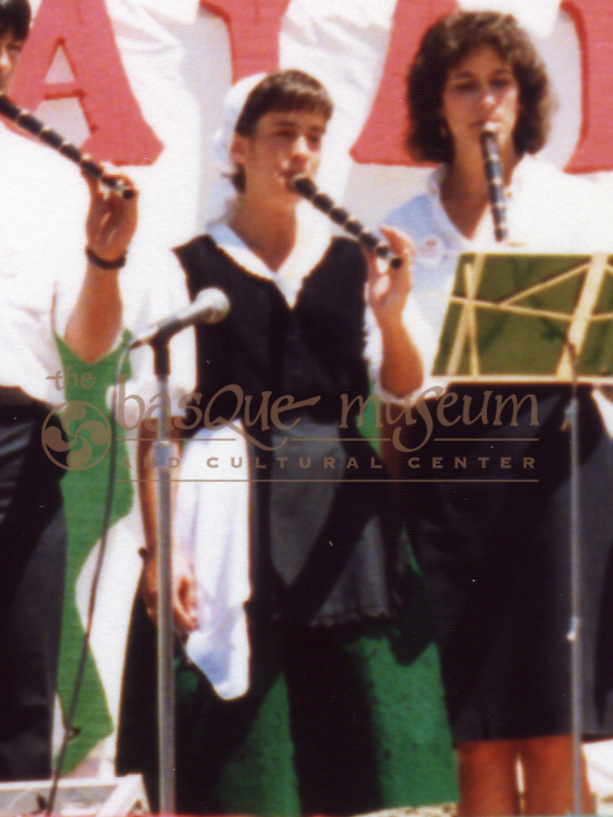
Josie was born in Boise, Idaho in 1969 to Julio and Julie Bilbao. She learned to play the txistu, dance the jota, and speak a few words of Basque from an early age, but still felt that something was missing. Her grandfather, Frank Bilbao, pressured his grandchildren to speak Basque, arguing the centrality of Euskera in Basque culture. Frank's insistence left an indelible mark, convincing Josie to learn to speak Basque.
Josie's story, while only a snapshot of her life as a young Basque-American, provides a glimpse into what having a Basque heritage means to second and third-generation Basques. In a succinct and personal way, Josie articulates the joys and pressures of growing up as a Basque-American balancing both cultures. She discusses the ways in which her cultural identity has evolved over the years as she has worked to preserve and live the Basque language and culture in the United States.
TAPE MINUTE SUMMARY OF CONTENTS
0-13:00 Born in Boise, Idaho, on March 19, 1969. Grew up outside of Kuna. Went to elementary school in Kuna. She moved to Moscow, ID, in 5th grade while her father (Julio Bilbao) was completing his doctoral dissertation. They moved back to Kuna for 1 year, went to Sacred Heart 1 year, and then moved to Boise. Drove to Boise for Basque Dancing, began in second grade. She remembers a music camp in the basement, at Basque Center. Music camp at BSU. Megan Donahue Overgaard and Dan Ansotegui taught dancing.
Before Junior High did you do many Basque things? Mom (Julie Bilbao) taught Anita (sister) and Josie how to play the txistu. Mom said that it would make their Aitxitxe (grandfather, Frank Bilbao) happy. She remembers the first lesson in kindergarten, from a 5-page book. They learned from a type of txistu. Practiced at home and then started playing with Jimmy Jausoro.
Language: Learned basic language hello, thank you. Heard a few basics as well. Dad’s grandmother (Francis’ mom) sang songs from Ondarroa, and Josie remembers having to listen after lunch, but did not appreciate it at the time. Nevertheless, she thinks it had an influence on her musically. She listened to accents. Josie’s sister, Amaia, speaks Spanish with a different accent than Anita and Josie because she didn’t have the experience of listening to the grandmother sing.
The Basque influence is due to Amuma (grandmother) and Aitxitxe (grandfather) on dad’s side. Aitxitxe spoke English to the kids and spoke Basque with Amuma. He said we needed to speak Basque and weren’t really Basque if we didn’t speak Basque. That’s quite a load to carry. Parents held the guilt, why didn’t they teach Basque to their children? Josie felt guilty too. Mom took lessons after she was married. Dad was around it more. She could get the gist of the conversation.
Did you want to speak Basque? Yes, I felt incomplete and left out without being able to speak it. It was a destiny to fill out that part of yourself. An itch – wanted to understand and didn’t have the tools to learn. Another part was a negative feeling. I don’t want to learn just because aitxitxe said we weren’t Basque. That was my thinking then. I knew I was capable. That’s why the Basque program (at Boise State) was so important. I wouldn’t have learned it with out Basque program classes and Olatz (teacher that came from the Basque Country and taught Basque at Boise State).
13:00-18:00 Remember motivations – txistu – to please aitxitxe. When we were 5 or 6 “aitxitxe would be happy”. Aitxitxe said we needed to learn Basque. Seeing how important it was to him, we knew that speaking Basque was part of his identity. Gave passion to dad and gave to Josie and Anita. Aitxitxe has a strong personality – dominates, and he was from there… Amuma is proud of being Basque and lives as American Basque. She doesn’t speak Basque to me. When I came back I spoke Basque to Amuma and she spoke English to me. Aitxitxe cried the first time we spoke Basque together, and always responds in Basque. Amuma doesn’t understand Batua, she was born here. Aitxitxe has the last word. It’s the dynamics of their relationship – dominant.
18:00-21:00 Do you remember identifying yourself as a Basque? When was the first time you remember being conscience of being Basque? Did you think you grew up differently? When I was in high school applying for scholarships checked “Other” on forms and wrote “Basque American.” In grade school during show and tell I brought Basque dolls. Wearing costumes for occasions at school, thought that was neat. I would say I was Basque when people asked. Wear the t-shirt “I’m a little Basco”. Got more attention, felt special, never negative reaction. Thought it was cool to say – Basque.
21:00-30:00 Oinkaris: Josie remembers going to Oinkari’s at first and feeling intimidated on the first day. Felt like everyone was best friends, and older. Didn’t know anyone. Didn’t like performing at nursing homes.
Was there a time when it felt forced, or negative? Felt weird about learning the txistu? No didn’t feel negatively toward Basque heritage, more towards grandfather. Growing up between you and cousins? Did you feel a difference between the ways you were involved in the Basque heritage? Feel more involved living in Boise? Mom has sister, Louise Lasaso, who has 4 kids and lives in Emmett on a dairy farm. Carmen Lasaso was an Oinkari.
More involved in Boise than other towns. Didn’t realize community here was so great at the time. Being Basque never brought up with cousins. Didn’t talk about what we did during Basque dancing. Sense of family is so strong. Not particular to Basque, a lot of cultures have that. Aitxitxe expects a lot out of everyone. Maybe expected more out of Basques. Because mom was Basque too – there was no excuse. Tía Dolores (father’s sister) and Tío George (Scandinavian) lived far away – plus closer lived to Amuma and Aitxitxe – more praise and criticism.
Tío George is very supportive of his wife. Uncle Frank didn’t marry Basque. Tía Nancy adopted 2 boys Dani and Toni. Tío Frank feels strongly about telling about Basques and their grandparents giving lots of info about where they came from – Tía Dolores too. Because Amuma Francis’ brother, Tío Gene Bicandi, lives in California, from Ondarroa – they are very close. Lots of stories.
TAPE 2
In Spain, I didn’t feel bad about speaking in Spanish the first time I went, because I needed to communicate. The second time, during the first week of the program I stayed at the dorm. All women were on one side of the dormitory. One night Spanish men assaulted them and yelled about how Basques were pigs. She had never heard that here. Grandmother was called a black Basco. In Boise, being Basque was always a positive thing. Didn’t know enough to argue. It really upset her. Understood the complexity. I was confronted with his passion for his culture. During the beginning of the trip it helped me see complexity of Euskadi. Glad to see Basque signs feel so much.
Idolization – romanticized the Basque country. Comes back when you go each time. Deep inside. Way we’ve been raised to think of it. Four people were in this program to learn Basque. One Mormon for mission, one boy skateboarder from Boston, and Denise and I. Got with Basque families and started learning Basque. At first she spoke Spanish and gradually learned Basque. Now that’s all we speak. Second time went back it was complete.
Went through phases of bashing Americans. Seeing it from new perspective. Hearing different views. Example: when you’d see Americans and cringe that’s who we are. In airport. We seem so loud and obnoxious. Not refined. The family that she stayed with never treated her differently about being American – much kinder view. He was a businessman. At some dinners with relatives in Lekeitio, cuadrilla members, were in her face attacking the U.S. Josie realized she is part of the U.S. During her first visit she was much more critical of U.S. and felt like she could separate herself and could live in the Basque Country and be more noble. Literature classes taught her that we are all part of the problem. We have to take ownership for the past. It seemed like it would be more noble to live in Euskadi because not American and part of the Basque culture. I have seen Basque struggle way of life and culture – healthy.
What did dinner at cuadrilla help you to realize? It made you recognize the overdone pride that you exhibited. Felt like how can you be so pompous. Why do you think you are so great? Criticizing all that aren’t Basque. Being critical of Basques. Realized the world is so much more complex. Thinks Basque is greatest thing on earth.
While taking a history class from a man who was politically involved, a Priest, passionate man, it strengthened her belief that Basque struggle was a noble cause.
Did it change the way you would have identified yourself? Yes, I am a Basque American, or American Basque because I am very American: independent, and there are things I wouldn’t want to change. I have the freedom to be an individual who can dress, eat what I want, when I want, and speak to whom I want. Everything there is so structured. I need more time to myself. I like to run and I was told to get off the street, and told that women shouldn’t be running on the street. I’m not just Basque. Living in the U.S. shaped me. Other half is spiritual identity – feeling love for hills and mountains. I feel how old it is, and know in my blood that’s part of who I am. In awe of how old the culture, language, and traditions are. You can break down words that mean things. The wisdom is beautiful things in culture. Love and want to preserve it.
Did you feel like you had more of a claim? Yes, I felt more of a claim than others in the program. Some people didn’t know what Basque was. It was a different experience for them.
Were you a more patriotic American? Saw benefits of living in America? Never considered myself to be patriotic. More cynical about what we don’t know about our country. I did feel love for American people. Airport obnoxious Americans, but felt how generous, open and kind Americans are. Thought of specific families – the Jones’. Love people – hospitable. Easy for people who live in Lekeitio to write them off. Didn’t know them, and called them yankees. Beautiful places in the U.S. that I want to see.
Tell great stories or jokes. Pleasant and nice to people. Felt born and okay here.
Saying hi on street, I’ve been critical of U.S. Phoebe Lunde, teacher at BSU, recognizing American part of self. Made me more accepting here.
What perspective Basque American culture here? While there, it seemed amazing to me what we have here: Oinkaris, Jaialdi, how can there be this group so far away that dances? Yes, it is amazing.
In our situation, we don’t have to decide to kill to preserve our culture, be imprisoned or tortured. Dancing in Oinkaris is ritzy, glitzy, and easy to put on. In high school and college we are very fortunate to have identity that we can study and show and take seriously. It’s there for us to pursue. Our peers don’t have that to dive into. We have the choice.
Is ethnicity a choice? Yes, we create the world and we decide who we want to be. We can change things. Don’t get anything for nothing. Have to work for it. Something you choose and work towards. It is a choice.
From choice – We’ve created an entirely separate thing it’s own product. Another version of Italian, black, variation? Other communities have many strong, continuing traditions and are bringing in new traditions. There are Basques in South America, in Euskadi, and Basques who speak Spanish and don’t dance.
NAMES AND PLACES
NAMES:
Ansotegui, Dan – taught dancing at the Basque Center.
Bicandi, Gene – grandmother’s brother.
Bilbao, Amaia – Josie’s sister.
Bilbao, Anita – Josie’s sister.
Bilbao, Francis – Josie’s grandmother.
Bilbao, Frank – Josie’s grandfather.
Bilbao, Julie – Josie’s mother.
Dolores – aunt, father’s sister.
Jausoro, Jimmy – played the txistu with Josie.
Lasaso, Carmen – an Oinkari.
Lasaso, Louise – Josie’s mother’s sister.
Lunde, Phoebe – professor at Boise State University.
Overgaard, Megan Donahue – taught dancing at the Basque Center.
PLACES:
Basque Center, Boise, Idaho – dancing lessons.
Boise, Idaho – city where Josie was born.
Boise State University – music camp.
Kuna, Idaho – Josie went to elementary school in this town.
Lekeitio – city in Euskadi where Josie has some relatives.
Moscow, Idaho – moved here in 5th grade.