
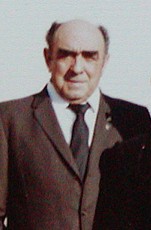
Sabin was born in Gatika, Bizkaia on 27 October 1918 to Gregorio Landaluce and Ines Bilbao. Sabin's childhood was divided between chores at home, going to school, and learning to play the txistu and tambourine. By the time he was 12, he was playing the txistu at festivals in Gatika and surrounding towns. He was teaching others to play not long afterward. Sabin's father worked as a sheep herder and lumberjack in the United States, leaving his wife and two children in Gatika. Sabin did not meet him until he immigrated to the US in 1952.
At 17, Sabin volunteered to fight in the Spanish Civil War. He was taken prisoner when Bilbao fell in June of 1937, and carried out his sentence in Bilbao, Logrono, Burgos, and Morocco. In north Africa, Sabin was part of a disciplinary road building crew. He was released after seven years and ten days. Home again, Sabin met his wife, Milagros, at a romería near Mungia. They married in 1948 and Sabin started a short career as a chauffeur. His father, who was still in the United States, arranged for him to immigrate four years later.
Not fond of sheep, Sabin spent only 12 days at the Nicholson lambing sheds in Kuna, Idaho before heading down to a tungsten mine in Nevada. He mined for a few years before finding work with Goicoechea in Hells Canyon, Idaho. Sabin arranged for his wife to join him in 1957. When she arrived, he and his father were staying in a boarding house on Grove Street in Boise. Sabin and Milagros settled in Boise, where they devoted themselves to raising a family and helping with music and costumes for the Oinkari Basque Dancers.
TAPEMINUTE SUMMARY OF CONTENTS
0-2:00 Sabin was born on 27 October 1918 in Gatika. His father was Gregorio Landaluce; his mother was Ines Bilbao. They were both from Gatika. Sabin has one sister, Elena, who still lives in Gatika.
2:00-6:45 His school was about half a kilometer away. Boys and girls were taught together and classes were held in Spanish. Every day around 11:00 am the teacher would send one of his students with a little money to buy him a bottle of wine, which he would sip throughout the day. Even so, Sabin remembers him being a good teacher. Sabin and his friends spoke Basque together in their free time, but only Spanish was allowed in school. His teacher did not punish them much for speaking Basque in school, but some teachers were known to hit their students on the fingernails with rulers if they misbehaved.
6:45-7:30 Sabin went to fight in the Spanish Civil War at the age of 17.
7:30-12:30 Sabin’s mother and older sister took care of him on the family’s baserri. His father had been in the United States since 1920, leaving the family behind to tend the farm. His father never returned to Gatika, but Sabin met him when he came to the United States. In the US, his father worked building railroads, on a lumber crew, and for a sheep company. He did not send the family any money, and did not write to them. Their mother could not support both children, so Sabin went to live with his father’s brother and his family. (His father’s brother was married to his mother’s sister – see minute 16).
12:30-27:00 Sabin enjoyed studying mathematics in school. Other responsibilities took priority over going to school, but he enjoyed the time he spent there. He finished at the age of 14. He worked on the farm, but did not have a paying job while he went to school. He worked on his aunt and uncle’s farm for three years then volunteered to fight in the Civil War. Many of his friends also volunteered, and one or two of them lost their lives. He fought for three years and was taken prisoner when Bilbao fell on 15 June 1937. He remembers being in Gernika when it was bombed earlier that year, sharing one of his memories. (Sabin and Milagros chat for a little while). As a result of the war he was imprisoned for 7 months and 10 days. The prison sentence was carried out in Bilbao, Logroño, San Pedro de Cardeñas in Burgos (an old convent) and a disciplinary work camp in northern Africa (Morocco – see minute 25-26) where he built roads. In Africa he was imprisoned with people from all over Spain, and remembers that prisoners were divided into work battalions. Surprisingly they ate well, but had to ask permission for everything.
27:00-30:00 Sabin learned to play the txistu and tambourine as a child. From the time he was 12 he played in festivals in Gatika and other towns, and also played for the Oinkari Basque Dancers for years. (Sabin sings an old drinking song). They called him “El txistu de Gatika.” Milagros remembers that she knew of him before the war, but met him after he finished his prison sentence. She explains how she first met him at a romería (an outdoor picnic/festival).
0-4:30 Sabin and Milagros dated for five years before they married. Milagros gives a little of her family history. After she finished elementary school at 14, she went to an academy. She was the youngest of three children. Her sister was a seamstress, her brother was a welder (soldador), and her mother ran a store. Her family lived in Mungia and would often go to romerías together. Milagros met her husband on one such outing. They married on 3 June 1948. Sabin jokes that they’ve been married for many years.
4:30-8:30 Before they married Sabin worked in a shop, Fundiciones Barrenetxe, that made chapas, or thin metal plates, for use in construction. After marrying a man named Barcelona offered him a job with the chauffeurs’ union. Sabin worked as a chauffeur (for almost five years – see minute 9) until he decided to come to the United States. He left his wife and two children in the Basque country, sending for them after he had worked in the US for four years. Milagros compares his job as a chauffeur, which had several nice perks, with his job in the US.
8:30-13:45 Sabin and Milagros have three children: Sabin Jr., María, and Josu. The first two were born in the Basque country. Milagros talks about what her children are doing. Josu is in Alaska and is a talented carpenter/artist. (The interviewers and narrators chat for a little while).
13:45-20:00 Sabin came to the United States as a sheepherder. His father arranged for his passage. Sabin was not cut out for working with sheep (Milagros says that the sight of ewes giving birth in the lambing sheds made him ill). Milagros remembers her husband telling her that he preferred prison to working with sheep. After he arrived in 1952, he spent only 12 days in the (Nicholson – see minute 17) lambing sheds in Kuna, Idaho. Then he went to Nevada to work in some tungsten mines for four years. By the time Milagros arrived in 1957, he was working for Goicoechea as a construction worker in Hells Canyon, Idaho. He retired at the age of 60. When Milagros arrived, Sabin and his father were staying in a Basque boarding house close to where the Basque Museum and Cultural Center now stands.
20:00-24:00 Before they came to the United States, Sabin and Milagros did not know much about the country. Sabin planned to return to the Basque country after working in the US for a little while. As the years passed, he saw changes in the old country that did not agree with him and became more and more inclined to stay in the US. Sabin and his family have made several visits to the Basque country, but have settled in the US. Their first trip was when Josu was three years old. They own an apartment in Gatika and pay someone to maintain it.
24:00-30:00 Sabin and Milagros talk about their involvement with the Basque Center and the Oinkari Basque Dancers. He played txistu, and she helped procure some of the costumes and accessories for certain dances. Milagros and Sabin explain why they decided to leave the Oinkaris before the World’s Fair in New York. They are still members of the Basque Center.
Tape 2, side 1
0-9:00 After years of not playing the txistu, Sabin was put on the spot at a Basque Picnic in Boise shortly after Milagros arrived. They laugh about how many mistakes he made. He had not played since he was young, and Franco had outlawed the txistu along with the Basque language. Nevertheless, he picked it up again and played for functions at the Basque Center. Milagros gives another example of her involvement in helping design costumes for the Oinkari Dancers.
9:00-12:30 She learned to drive some 15 days after she arrived. She drove her children to sporting events. She tells how she registered and took her driver’s exam to get her license. Milagros has always been very self-sufficient, even though she describes her life in the old country as a life of leisure (“vivía como una señora”).
12:30-14:15 Sabin tends an extensive vegetable garden behind his house, and Milagros makes her own chorizos. Milagros, who has done much of the narrating during the interview, says that she used to be very quiet in the Basque country. She laughs, saying that she started talking a lot when she came to the US.
14:15-20:00 Sabin and Milagros became US citizens before Josu was born. They attended citizenship classes at Boise High School. After living in the US for a few years, they preferred life here to life in the Basque country. Sabin says that a person can live their life here as nowhere else, and Milagros appreciates being able to buy new things without feeling jealousy from friends and neighbors. Even though she cannot complain about her life in Mungia or Gatika, she prefers life in Boise. Her father went to Mexico to make some money but decided to stay there, leaving his family in Mungia. Even so, her mother provided for the family. They never went hungry. After visiting the Basque country a few times, Sabin decided to stay in the US. He would like to make one more trip.
20:00-26:00 In the beginning, it was difficult to adjust to the English language and establish himself financially. Learning English was especially difficult. Milagros speaks very little English. They comment on some of the differences in lifestyle between the US and Euskadi, saying that it would be impossible to live a fully Basque lifestyle in America. For example, it would cost too much to go out for drinks or appetizers (pinchos) as often as people in the Basque country do. Both narrators feel more at home in Boise than in the Basque country. In addition, it has become more difficult to travel as they have gotten older.
26:00-30:00 They keep in touch with family and friends in the Basque country by telephone. (Interviewers and narrators chat. Milagros and Sabin warn the interviewers about marrying too early, and tell them to be wary of certain girls).
0-4:00 More informal conversation. Sabin enjoys wine with meals, but Milagros prefers water.
NAMES AND PLACES
NAMES:
Bilbao, Ines – Sabin’s mother.
Franco, Francisco – Spanish dictator.
Fundiciones Barrenetxe – one of Sabin’s employers in the Basque country.
Goicoechea – owned a construction company.
Landaluce, Elena – Sabin’s sister.
Landaluce, Gregorio – Sabin’s father.
Landaluce, Josu – son.
Landaluce, María – daughter.
Landaluce, Sabin Jr. – son.
Nicholson – owned lambing sheds in Kuna.
Oinkari Basque Dancers
PLACES:
Basque Center, Boise, Idaho
Basque Museum and Cultural Center, Boise, Idaho
Bilbao, Bizkaia – mentioned in connection to the Spanish Civil War.
Boise High School, Boise, Idaho – Sabin and Milagros took citizenship classes here.
Gatika, Bizkaia – Sabin’s birthplace.
Gernika, Bizkaia – mentioned in connection to the Spanish Civil War.
Hells Canyon, Idaho
Kuna, Idaho – Sabin’s first job in the US was at lambing camp here.
Logroño – Sabin spent part of his prison sentence here.
Morocco – Sabin spent part of his prison sentence here.
Mungia, Bizkaia – Milagros’ birthplace.
Nevada – Sabin worked as a miner here.
New York, New York – mentioned in connection to the World’s Fair.
San Pedro de Cardeñas, Burgos, Spain – Sabin spent part of his prison sentence here.
THEMES:
Basque clubs and organizations
Construction
Family
Food
Language
Mining
Music
Sheep herding
Spanish Civil War